“I’ve heard that we are born alone and we die alone. But one thing I’ve learned from here is that, we don’t have to live alone.” (Pann)
Yes, we did everything together, participatory decision-making, having lots of fun, and winning collaborative games with no one left behind. Our powerful mantram was “Connect, connect, connect!” And it was amazing how we could connect to each other in such a short time!
Connection and trust are the foundation of any relationship, as well as leadership. I’ve learned that trust is empowerment and real power comes by empowering people. As trust is based on integrity, the leadership development journey is an individual quest for inner transformation, of self-discipline and character building. Thus, leadership is not a position but rather a way of living, leading one’s own life with vision and purpose, manifesting love through selfless-service. And we can help each other along the way.
Thank you all for the happy and inspiring time we had together!
Some short notes from the workshop "Design your Dream Life", co-organized by Bright and One Life Connection on 27.10.2018 at Toong.
The 5 Rules for Optimal State of Being
1. Be honest: build trust, and inner confidence by sincerity and speaking the truth.
2. Speak up: open and love yourself enough.
3. Be engaged: focus and committed to your goal.
4. Be interested rather than interesting.
5. Be social: proactively engage, be connected, not socially influenced.
Think about these questions:
- If tomorrow was your last day, what would you do?
- Spend time with family (soul family).
Finding your life's purpose through analyzing your Ikigai - the reason you want to wake up every morning. Write one thing for each sentence:
- What you love doing.
- What the world needs.
- What you are good at.
- What you can be paid for.
Are they the same? Even if there is nobody pay you, you still do it. "This is what I want." Then, you are all in.
Our well-being includes Body, Emotions, Mind and Ikigai. Body energy comes from a healthy lifestyle. Controlled emotions. Calm, clear and strong Mind that can transform the negative patterns.
Ask yourself:
- Are you doing what you want to do or what others want you to do?
When you are true to yourself, then your life is your dream life.
Be yourself. Be grateful for all the good things in your life.
The group photo that we put right at the first page of our folder.
On September 15th, we were lucky again to have Natalie Pham with us for a whole day training on Multiple Intelligences and especially the "6 Habits of Highly Effective Teachers", which is also the name of her debut book. She was lively and wonderful as always, full of positive energy. Love her teaching and love her generosity.
MULTIPLE INTELLIGENCES
(actually there are 9 types, including the existential one)
LEFT BRAIN AND RIGHT BRAIN TEST
My result: 50% Left and 50% Right Brain.
***** BLOOM'S REVISED TAXONOMY
*****
6 HABITS OF HIGHLY EFFECTIVE TEACHERS
Habit 1. Lesson is focused on objective
Highly effective teachers have a clear plan of what they want to do.
SMART Objectives
Specific: State what exactly what you want to accomplish (Who, What, Where, Why)
Measurable: How will you demonstrate and evaluate the extent to which the goal has been met?
Achievable: Stretch and challenging goals within ability to achieve outcome. What is the action-oriented verb?
Realistic (Relevant): How does the goal tie into your key responsibilities? How is it aligned to objectives?
Time-bound: deadlines, dates, time, frequency...
Criteria: Students can explain what they are learning.
- Tools to organize the content: vocabulary chart, venn diagram, mind map, analogy...
Criteria: Explanations are short and thoroughly explaining concepts in a direct and efficient way.
The teacher makes connections with other content areas, students' experiences and interests, or current events in order to make the content connected to build student understanding and interest.
Students ask higher-order questions and make connections by themselves...
Habit 3. Teaching Time is maximized
All the time in class is used effectively.
- Think of procedure to minimize time wasted (step 1, step 2...)
- Timer, time keeper (can be student), agenda: set and reinforce time limits
- Classroom management, action plan...
Criteria: Routines and procedures run smoothly and students generally know their responsibilities and do not have to ask questions.
Transitions are orderly and efficient.
No idle time.
Students share responsibilities for the routines in the class.
The lesson progresses at a fast pace, such that students are never disengaged and students who finish early have something else meaningful to do.
- KWL (What you know, What you want to know, What you've learned)
- Kahoot, Quizziz...
- Small boards
- A-B-C-D
- 5 Fingers
- Brain break: Go noodles...
Criteria: The teacher provides students more than one way to engage with content, as appropriate, and all ways are matched to the lesson objective (ex: a Socratic seminar might involve verbal/linguistic and interpersonal ways).
Students respond positively and are actively involved in the work.
Habit 5. Check for understanding
Asking clarifying questions
Asking reading comprehension questions
Asking students to rephrase material
Conferencing with individual students
Drawing upon peer conversation/explanations
Having students respond on the boards
Having students vote on answer choices
Moving around to look at each group's work
Observing student work in a structured manner
Scanning progress of students working independently
- Exit slips
- A-B-C-D
- Five fingers
- Kahoot, Quizziz...
- Thumb up/down
- Small boards
Criteria: The teacher checks for understanding at all key moments.
Every check gets an accurate "pulse" of the class's understanding.
The teacher uses a variety of methods of checking for understanding.
The teacher seamlessly integrates information gained from the checks by adjusting the content or delivery of the lesson, as appropriate.
Habit 6. Positive interactions
Love is natural.
Modelling, for more compassionate and kind kids, who are willing to help others.
The I message: "I feel.....
When you....
and I want....."
Positive comments, praise and compliments
- Good job!
- Well done!
- Awesome!
- Close enough.
- Almost there.
- Nice try
- Excellent...
- Amazing!
- I love it.
Personalized handshakes....
Criteria: Students are invested in the success of their peers (collaborating with and helping each other...) and may demonstrate frequent positive engagement with their peers. Students may give unsolicited praise or encouragement to their peers for good work. There is evidence that the teacher has strong, individualized relationships with students in the class (the teacher might demonstrate personal knowledge of student's lives, interests, and preferences. Feedback
"The possible applications of the Internet of Things are more or less endless. Basically any device or
product can be made ‘smart’ when several sensors are added and thedevice can connect to the Internet. Throw in some smart algorithms and the data can be analyzed and provide insights to the user as well as the device itself. With so many possibilities, cheap infrastructure and high demand it is very likely that we will see an explosion of IoT startups in the coming years" ~ Mark van Rijmenam.
“Internetof Things (IoT) enables the objects in our environment to become active participants, i.e., they share information with other members of the network or with any other stakeholder and they are capable of recognizing events and changes in their surroundings and of acting and reacting autonomously in an appropriate manner. In this context the research and development challenges to create a smart world are enormous. A world where the real, digital and the virtual are converging to create smart environments that make energy, transport, cities and many other areas more intelligent.
The concept goal of the Internet of Things is to enable things to be connected anytime, anyplace, with anything and anyone ideally using any path/ network and any service. Internet of Things is a new revolution of the Internet. Objects make themselves recognizable and they obtain intelligence thanks to the fact that they can communicate information about themselves and they can access information that has been aggregated by other things. For example - alarm clocks will go off early if there’s traffic; plants will communicate to the sprinkler system when it’s time for them to be watered; running shoes communicate time, speed and distance so that the wearer can compete in real time with people on the other side of the world; medicine containers tell your family members if you forget to take the medicine. All objects can play an active role thanks to their connection to the Internet." ~ Ovidiu
Vermesan et al.
Enabling technologies for the Internet of Things such as sensor networks, RFID, M2M, mobile Internet, semantic data integration, semantic search, IPv6, etc. are considered in and can be grouped into three categories (DuPress):
(i) technologies that enable “things” to acquire contextual information,
(ii) technologies that enable “things” to process contextual information, and
(iii) technologies to improve security and privacy.
Potential applications of the IoT are numerous and diverse, permeating into practically all areas of every-day life of individuals, enterprises, and society as a whole (Source: IoT Cluster Book).
Smart Cities
Smart Parking: Monitoring of parking spaces availability in the city.
Structural health: Monitoring of vibrations and material conditions in buildings, bridges and historical monuments.
Noise Urban Maps: Sound monitoring in bar areas and centric zones in real time.
Traffic Congestion: Monitoring of vehicles and pedestrian levels to optimize driving and walking routes.
Smart Lightning: Intelligent and weather adaptive lighting in street lights.
Waste Management: Detection of rubbish levels in containers to optimize the trash collection routes.
Intelligent Transportation Systems: Smart Roads and Intelligent
Highways with warning messages and diversions according to climate conditions and unexpected events like accidents or traffic jams.
Smart Environment
Forest Fire Detection: Monitoring of combustion gases and preemptive fire conditions to define alert zones.
Air Pollution: Control of CO2 emissions of factories, pollution emitted by cars and toxic gases generated in farms.
Landslide and Avalanche Prevention: Monitoring of soil moisture,vibrations and earth density to detect dangerous patterns in landconditions.
Earthquake Early Detection: Distributed control in specific places of tremors.
Smart Water
Water Quality: Study of water suitability in rivers and the sea for fauna and eligibility for drinkable use.
Water Leakages: Detection of liquid presence outside tanks and pressure variations along pipes.
River Floods: Monitoring of water level variations in rivers, dams and reservoirs.
Smart Metering
Smart Grid: Energy consumption monitoring and management.
Tank level: Monitoring of water, oil and gas levels in storage tanks and cisterns.
Photovoltaic Installations: Monitoring and optimization of performance in solar energy plants.
Water Flow: Measurement of water pressure in water transportation systems.
Silos Stock Calculation: Measurement of emptiness level and weight of the goods.
Security & Emergencies
Perimeter Access Control: Access control to restricted areas and detection of people in non-authorized areas.
Liquid Presence: Liquid detection in data centers, warehouses and sensitive building grounds to prevent break downs and corrosion.
Radiation Levels: Distributed measurement of radiation levels in nuclear power stations surroundings to generate leakage alerts.
Explosive and Hazardous Gases: Detection of gas levels and leakages in industrial environments, surroundings of chemical factories and inside mines.
Retail
Supply Chain Control: Monitoring of storage conditions along the supply chain and product tracking for traceability purposes.
NFC Payment: Payment processing based in location or activity duration for public transport, gyms, theme parks, etc.
Intelligent Shopping Applications: Getting advice at the point of sale according to customer habits, preferences, presence of allergic components for them or expiring dates.
Smart Product Management: Control of rotation of products in shelves and warehouses to automate restocking processes
Logistics
Quality of Shipment Conditions: Monitoring of vibrations, strokes,container openings or cold chain maintenance for insurance purposes.
Item Location: Search of individual items in big surfaces like warehouses or harbours.
Storage Incompatibility Detection: Warning emission on containers storing inflammable goods closed to others containing explosive material.
Fleet Tracking: Control of routes followed for delicate goods like medical drugs, jewels or dangerous merchandises.
Industrial
M2M Applications: Machine auto-diagnosis and assets control.
Indoor Air Quality: Monitoring of toxic gas and oxygen levels inside chemical plants to ensure workers and goods safety.
Temperature Monitoring: Control of temperature inside industrial and medical fridges with sensitive merchandise.
Ozone Presence: Monitoring of ozone levels during the drying meat process in food factories.
Indoor Location: Asset indoor location by using active (ZigBee) and passive tags (RFID/NFC).
Vehicle Auto-diagnosis: Information collection from CanBus to send real time alarms to emergencies or provide advice to drivers.
Smart Agriculture
Wine Quality Enhancing: Monitoring soil moisture and trunk diameter in vineyards to control the amount of sugar in grapes and grapevine health.
Green Houses: Control micro-climate conditions to maximize the production of fruits and vegetables and its quality.
Meteorological Station Network: Study of weather conditions in fields to forecast ice formation, rain, drought, snow or wind changes.
Compost: Control of humidity and temperature levels in alfalfa, hay, straw, etc. to prevent fungus and other microbial contaminants.
Domotic & Home Automation
Energy and Water Use: Energy and water supply consumption monitoring to obtain advice on how to save cost and resources.
Remote Control Appliances: Switching on and off remotely appliances to avoid accidents and save energy.
Intrusion Detection Systems: Detection of window and door openings and violations to prevent intruders.
Art and Goods Preservation: Monitoring of conditions inside museums and art warehouses.
eHealth
Fall Detection: Assistance for elderly or disabled people living independent.
Medical Fridges: Control of conditions inside freezers storing vaccines, medicines and organic elements.
Sportsmen Care: Vital signs monitoring in high performance centers andfields.
Patients Surveillance: Monitoring of conditions of patients inside hospitals and in old people's home.
Ultraviolet Radiation: Measurement of UV sun rays to warn people not to be exposed in certain hours.
IoT and Community Wisdom (Source: IoT Cluster Book)
People live in communities and rely on each other in everyday activities. Recommendations for a good restaurant, car mechanic, movie, phone plan etc. were and still are some of the things where community knowledge helps us in determining our actions.
While in the past this community wisdom was difficult to access and often based on inputs from a handful of people, with the proliferation of the web and more recently social networks, the community knowledge has become readily available - just a click away.
Today, the community wisdom is based on conscious input from people, primarily based on opinions of individuals. With the development of IoT technology and ICT in general, it is becoming interesting to expand the concept of community knowledge to automated observation of events in the real world.
IoT Challenges
“While ICT offers opportunities like a platform for freedom of speech, social contact and enhanced democratic accountability, there are also ethical problems online: for example important questions like privacy and data protection. As ICT becomes ever more important, pervasive and useful, we need to raise and discuss these ethical question.
The Internet of Things promises to bring smart devices everywhere, from the fridge in your home, to sensors in your car; even in your body. Those applications offer significant benefits: helping users save energy, enhance comfort, get better healthcare and increased independence: in short meaning happier, healthier lives. But they also collect huge amounts of data, raising privacy and identity issues.” ~ Neelie Kroes
"ICT revolutions since the invention of the first single-chip microprocessor in 1971 have transformed the way we live, work and do business. By giving autonomy to objects, and by blurring the line between bits and atoms, the Internet of Things will produce another quantum leap forward on both the technological and societal levels by erasing boundaries between information entities and moving the reality across traditional legal, business, social and cultural concepts towards a single environment. The scale of the challenge is unprecedented." ~ Gérald Santucci
Some Research Challenges
Absolutely safe and secure communication with elements at the network edge
Energy saving robust and reliable smart sensors/actuators
Technologies for data anonymity addressing privacy concerns
Dealing with critical latencies, e.g. in control loops
System partitioning (local/cloud based intelligence)
Mass data processing, filtering and mining; avoid flooding of communication network
Real-time Models and design methods describing reliable interworking of heterogeneous systems (e.g. technical / economical/ social / environmental systems).
Identifying and monitoring critical system elements
Detecting critical overall system states in due time
System concepts which support self-healing and containment of damage; strategies for failure contingency management
Technologies supporting self-organisation and dynamic formation of structures / re-structuring
"Funding Opportunities for Research and Academic Cooperation in Germany"
Dr. Annette Klosa, Head of DAAD Information Centre HCMC www.daadvn.org/hcmc
On Monday 14.12.2015, at SEAMEO Regional Training Center, HCMC, DAAD
organized the seminar "Research in Germany" to introduce about the
German research landscape in general as well as research opportunities
at German universities and various scholarship programs.
Germany is home of 105 Nobel Laureates. Beside academic area, industry
also plays an important role in research. Three pillars of the German
research sector are universities (1), non-universities/research
institutes (2) and industrial research (3). There are good reasons for
studying or doing research in Germany, such as diverse range of study
and research opportunities, excellence in research and instruction,
close link between theory and practice, strong international focus and
diverse funding opportunities.
German Academic Exchange Service (DAAD):
Independent organisation of German institutions of higher education,
funded by the German federal Government and dedicated to world-wide
academic cooperation www.daad.de
TU9is the alliance of leading institutes (research universities) of
Technology in Germany. They stand for excellent research and teaching in
engineering and natural sciences.
RWTH Aachen
TU Berlin
TU Braunschweig
TU Darmstadt
TU Dresden
Leibniz Universität Hannover
Karlsruhe Institute of Technology (KIT)
TU München
Universität Stuttgart
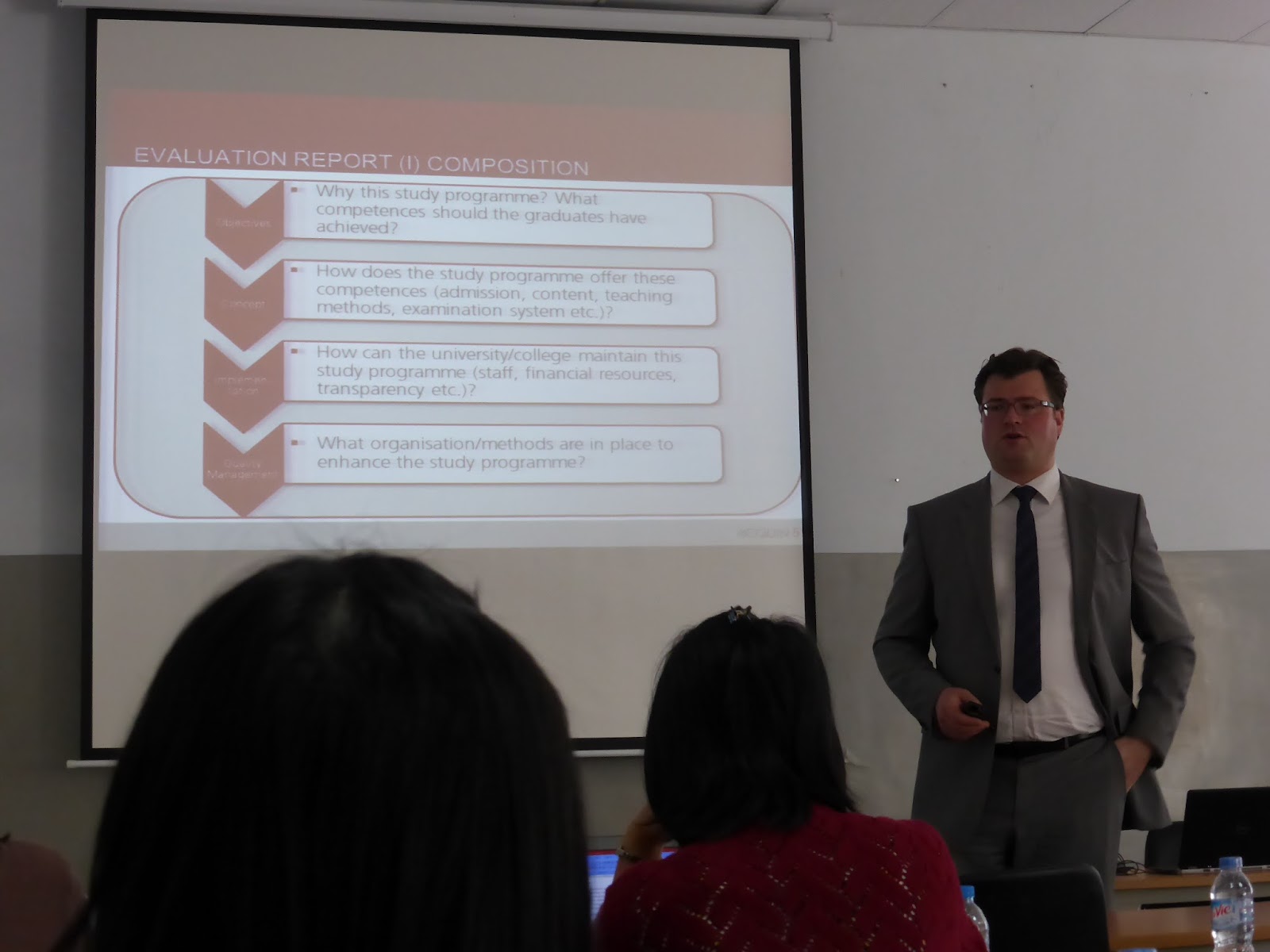
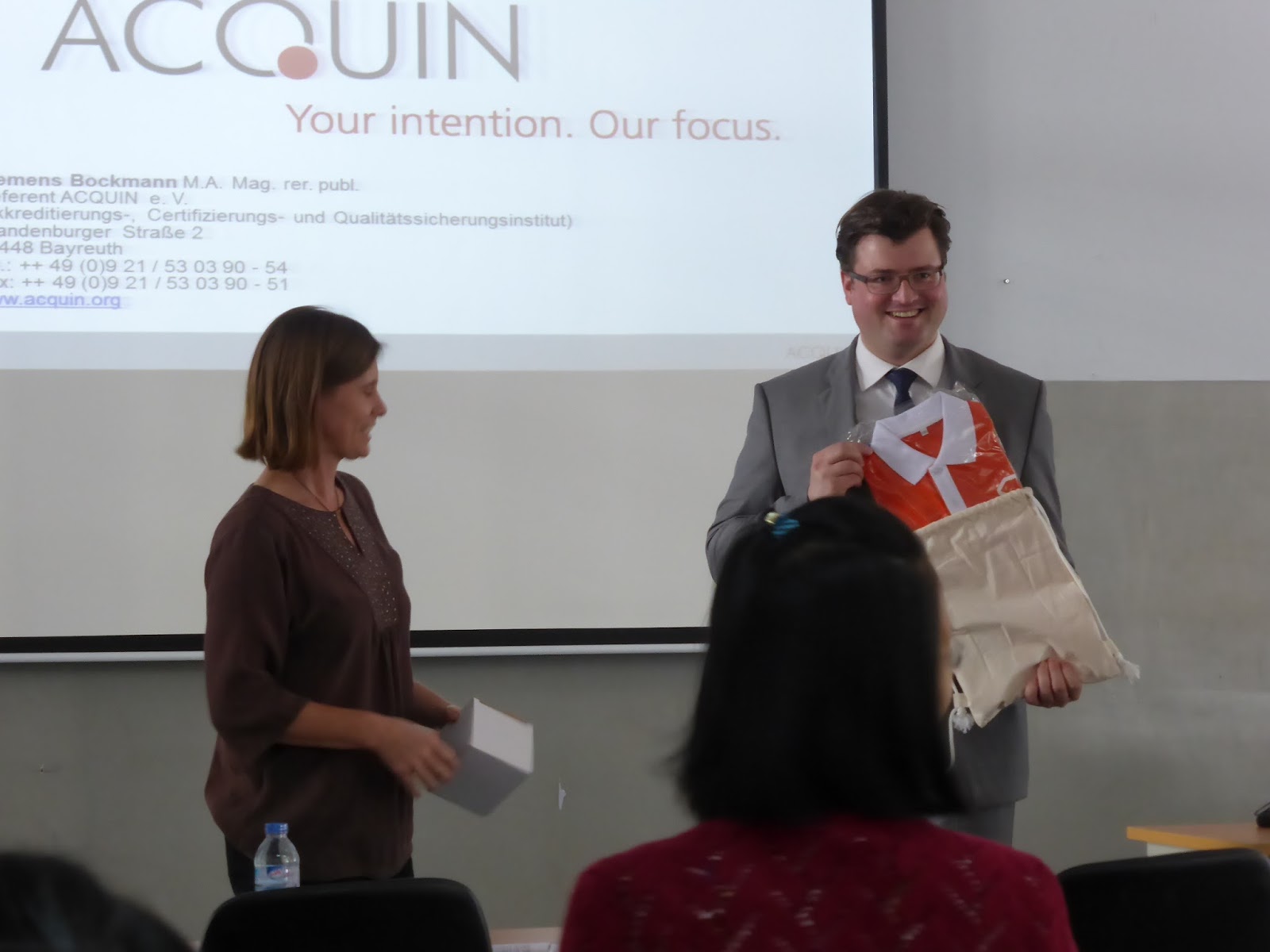
The
first week of December at VGU was marked by the visit of the
accreditation team ACQUIN and the representatives of VGU Consortium (Dr.
Dietmar Ertmann and Ms. Nicole Binder) from Germany. On the 1st and 2nd
of December, the peer group including Prof. Dr. Rudolf Stauber
(Frederik-Alexander University Erlangen-Nuremberg), Ms. Tina Agsten
(student of "Technology Management, University of Stuttgart) and Mr.
Clemens Bockmann (ACQUIN) had discussions with the President Board, the
academic and administrative staff for the accreditation work of VGU.
On
the 3rd and 4th of December 2015 at VGU campus, Mr. Clemens Bockmann
gave us an introduction to accreditation in Germany with the approach of
ACQUIN.
"Higher education accreditation
is a type of quality assurance process under which services and
operations of educational institutions or programs are evaluated by an
external body to determine if applicable standards are met. If standards
are met, accredited status is granted by the agency" (Wiki).
The
objectives of accreditation in Germany are to implement formal
regulations (developed by the German states and the Accreditation
Council), scientific standards and state-of-the-art-content in the study
programmes (defined by the scientific community), adjusting the study
programme to the necessities of the labour market and supporting students.
For detailed information on accreditation procedures and criteria, the guidelines can be downloaded at:
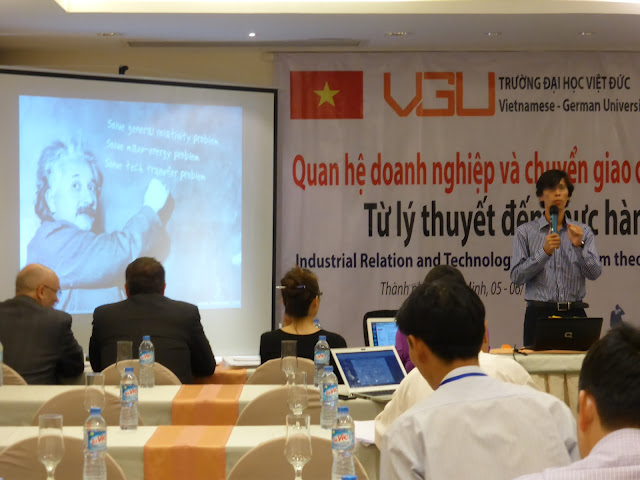
On
the 5th-6th of November 2015, VGU organized the workshop “Industrial
Relation and Technology Transfer: From Theory to Practice” in Ho Chi
Minh City. The workshop aimed to provide fundamental knowledge in
technology transfer and intellectual property, as well as to facilitate
discussion, mutual learning from practical examples and experiences in
Vietnam and other neighboring countries, and furthermore, to establish a
network of universities, research institutions, and enterprises for
future collaboration in technology transfer. Participants were coming
from various universities, research institutions, departments of science
and technology (DOST) and enterprises.
What is Technology Transfer? Technology transfer, also called transfer of technology (TOT), is the
process of transferring skills, knowledge, technologies, methods of
manufacturing, samples of manufacturing and facilities among governments
or universities and other institutions to ensure that scientific and
technological developments are accessible to a wider range of users who
can then further develop and exploit the technology into new products,
processes, applications, materials or services. It is closely related to
(and may arguably be considered a subset of) knowledge transfer
(Wikipedia).
Technology Transfer in Vietnam - Current Status, Potentials & Challenges
Although both technology transfer and intellectual property were
perceived as important to society, it was mostly considered that they
are still on the early stage of development in Vietnam with many
challenges ahead. However, there are also opportunities for Vietnam as
we are opening to the global integration process.
According to Mr. Do Nam Trung (DOST HCMC), currently, Vietnam's
technology level is ranked at the position of 92/140 in the world (World
Economic Forum Report 2015); among 12 member countries of TPP, Vietnam
has the lowest technology level, far behind 2-3 generations, as compared
with others. We are still passive in technology innovation with mostly
short-term problem solving and not long-term technology innovation
linked with new product development. There is also limitation in R&D
activities because of lack of information, experience and finance. It
is obvious that we need to enhance our National Innovation System.
Dr. Michael Braun’s analysis showed that Vietnam’s economy is highly
dependent on foreign technology and assembly processing. Vietnam
economic development has been based on exploitation of natural resources
and cheap labours. Vietnam mostly has no added value on technology.
Large national enterprises serve mostly national markets. They have
typically a medium technology level. Foreign-invested enterprises often
have high technology level, but rely on technologies provided by their
parent companies. Most SMEs work in low-tech sectors for local/national
markets. Only a very small share have an advanced level of
manufacturing technology and less than 5% employ university graduates.
There is a large number of research institutions as potential
“technology producers” but measurable outputs are still very limited.
Research and knowledge are available in many fields but uneven
distributed (high degree of regional concentration).
SWOT analysis of Technology Transfer in Vietnam today Slide credit: Dr. Michael Braun (2015)
A/Prof. Nguyen Anh Thi shared the same concern that Vietnamese
enterprises have just moved values around, and not yet created true
values because just by moving values around they have already got
benefits. And thus there was no pressure for them to create values.
Universities and research institutes do not have business model, and are
weak in customer relationship.
Dr. Michael Braun also noted that technology transfer in Vietnam is
highly regulated with (unnecessary) extremely detailed regulations for
every aspect. While in Germany, technology transfer is like a business
in a free market. Instead of detailed regulations, only framework is
provided which let the actors negotiate and deal it themselves. Law is
there to encourage and to ensure the rights of the investors.
Improving competitiveness of Vietnamese SMEs is a mission for technology
transfer. A number of intermediate mechanisms have existed and emerged
to support technology transfer such as technology transfer centers (sàn
giao dịch công nghệ), Tech Mart (internet-based platform for technology trade), and Technology Parks (Saigon Hi-Tech Park, Quang Trung Software City, Hoa Lac Hi-Tech Park, Danang Hi-Tech Park),
etc. Technology incubators provide the environment for the systematic
nurturing of young companies before they are ready for venture capital
funding. Co-location of new university campuses with high-tech parks is a
dedicated effort to create favorable conditions for linking high-tech
training, research and development with production and services,
stepping up innovations, nursery of technology enterprise and
commercialization of high technologies (Dr. Michael Braun). As we can
clearly see, innovations in Vietnam mostly focus on ICT, because ICT has
the lowest barriers (A/Prof. Nguyen Anh Thi).
According to DOST HCMC, Ho Chi Minh city also have several programs to
support tech-business such as policy for enterprise’s fund on science
and technology development, program to encourage manufacturing of
equipments that can substitute imported products, program for energy
saving and efficient use in business, programs to develop incubators for
technology startups. It was suggested that the city should facilitate
startup ecosystem to promote innovation, establishing venture capital
fund through public-private-partnership (PPP) and investing much more on
science and technology development, especially on enhancement of
research capacity in science and technology institutions.
Innovation in nowaday information age - high speed of science and
technology development - is a decisive factor towards a knowledge
economy. It is an important element that directly affects productivity,
efficiency and competitiveness of enterprises. As Vietnam participating
in TPP and joining global integration process, with higher requirements
in standards, quality, intellectual property, enterprises will have to
invest more in innovation and modernization. Enterprises’ innovation
need also means high demand for technologies from research. What should we do to foster technology transfer in Vietnam, particularly in universities?
Solutions to move forward technology transfer in Vietnamese
universities, research institutes were addressed in discussions. In
general, it was agreed that research should be directed to more
practical applications, and there should be more collaborations,
partnerships and connections not only between universities, governmental
agencies and industries but also among universities and research
institutes themselves. Therefore, this workshop is the first foundation
step for further collaboration among universities on technology
transfer.
Remark on Technology Transfer concept Slide credit: Assoc. Prof. Dr. Nguyen Anh Thi (2015)
Prof. Evelyn Taboada and A/Prof. Nguyen Anh Thi shared the same view
that technologies from universities should be put in business model in
order for them to bring values to society. For fostering innovations, it
is essential to nurture a startup ecosystem of various supportive
elements. While in the previous nursery/incubator model, relationships
among different elements are indirect through the incubator, in the new
model of startup ecosystem, relationships are direct to each other
elements through network. Thus, networking is very important in startup
ecosystems.
Elements of a startup ecosystem Source: http://www.startupcommons.org/what-is-startup-ecosystem.html
How to create economically valuable technologies? Slide credit: Assoc. Prof. Dr. Nguyen Anh Thi (2015)
Beside market/technology push approach, it is important to consider the
market pull one. In order to create economically valuable technologies,
market watch should be done to understand needs before assigning
research projects to scientists. This customer-centric approach will
help to connect research with practical needs of society and thus,
bringing successful technology transfer in the market.
Technology Push vs. Market Pull Slide credit: Dr. Michael Braun (2015)
Dr. Michael Braun emphasized the importance of capacity building,
interpersonal skills training and creating entrepreneurship/spirit in
students. The “T-shaped” entrepreneur has both the breadth of knowledge
about design, entrepreneurship, leadership, innovation and the depth of
knowledge in a particular discipline. “Good people like this they do not
grow on trees.” It is a lot about practical experience. Thus, we should
bring people from industry and invite them to talk to students. This
will give us two effects, people can learn from the experience and
students are motivated.
The "T-shaped" Entrepreneur Slide credit: Dr. Michael Braun (2015)
Courses on entrepreneurship have been taught in TU Darmstadt and TU
Dresden where students came from interdisciplinary majors (business,
engineering, science) get together and forming startups. Internally,
technology transfer seeks also to help facilitate interdisciplinary
R&D collaboration for new customer-oriented solutions. VGU also has
the MBA program which focuses on Innovation Management in SMEs.
To professionalize technology transfer, many universities have
established dedicated units. Stanford university has Office of
Technology Licensing focusing on achieving commercial success from
Stanford’s research-based innovations. Max-Planck Society has a
dedicated technology transfer subsidiary which provides services for all
Max-Planck institutes. The effort pays as the number of successful
innovators from Max-Planck’s research is continuously growing.
At VGU, our objective is to professionalize our relations with all
our partners and bundle technology transfer and research offerings.
Example VGU: Technology Transfer and Industrial Relations Slide credit: Dr. Michael Braun (2015)
Nowaday, technology transfer is more than only licensing, and involving
in the creation of new ventures/spin-offs. Starting a company requires
not only money but also commitment and good management. The
Entrepreneurship Center in Technical University of Munich provides
spin-off services and support their development.
Example from University of Munich - Entrepreneuship Center and Spin-off Services Slide credit: Dr. Michael Braun (2015)
On the other hand, in order for university to create conditions where
its staff or students are willing to invest in technology development
and to take risks, it should have a very clear policy how to share cost,
benefits and other things such as the example from MIT.
Example from MIT - Financial policy to foster research and technology transfer Slide credit: Dr. Michael Braun (2015)
What universities and research institutes can do to foster technology transfer can be summarized in the following figure:
What can universities and research institutes do to foster Technology Transfer? Slide credit: Dr. Michael Braun (2015)
Technology transfer as a “business process”
How do you know if a new idea from research is a good idea? Investment
decisions must be based on a thorough evaluation. You can have the best
invention in the world, but if it does not fit with the need of the
society, you have invented a solution which is desperately looking for a
problem! (Exercise of assessment Segway technology as a solution for
transportation in Vietnam).
There are three assessment dimensions that should be taken into account (Dr. Michael Braun):
1. The innovator’s potential - Can the innovator realize it?
Does the innovator have the necessary competencies?
Can he build a strong market position?
Does he have the resources?
2. Technological potential - Is it technically feasible and attractive?
Is it an innovation?
Does it provide technical and competitive advantages?
Can it be protected?
3. Market potential - Is the business attractive and sustainable?
Are market volume & growth sufficient to earn money?
Is it a profitable market/can they make money?
Can they enter the market successfully?
From ideas to innovations Slide credit: Dr. Michael Braun (2015)
From ideas to market success Slide credit: Dr. Michael Braun (2015)
Different approaches, skills and actors required during Technology Transfer process Slide credit: Dr. Michael Braun (2015)
Commercialization of new technologies is the final step in the transfer
of a specific technology. Timing is important as missing the right
moment means missing the opportunity. There are various types of
innovations with commercial market potential.
Types of innovations with commercial market potential Slide credit: Dr. Michael Braun (2015)
What are potential technology transfer customers asking for? The most
obvious answer is product innovation (technology progress, new/extended
functions, customer's convenience, non-physical goods). But there are
more of that, there are not only product innovation but also service
innovation, market innovation, etc. Process innovation has high need in
the manufacturing sector. Successful innovation does not always have to
be "high-tech" as in the case of business model innovation (example of
J. C. Decaux and his idea of Abribus, providing free bus waiting
shelters for people, and got benefits from advertisement) or
modernization of indigenous enterprises in traditional sector (example
of Vinh university helped indigenous enterprise improving fish sauce
production).
Intellectual property management
Protection of your innovations Slide credit: Dr. Michael Braun (2015)
Different IP Marketing Strategies for considering:
Selling
Licensing (licensing fees, royalties): exclusive licensing or non-exclusive licensing.
Joint venture; partnerships
Start-ups/Spin-offs
Transfer negotiation
Prepare your negotation meeting well is one step to a successful
negotiation. Thinking of what do you want to achieve and finding a fair
value where both parties can be satisfied at the end. It is important to
be fair as for future and further collaboration. Different expectations
should be considered. Some thoughts about building technology marketing strengths (Dr. Michael Braun)
Some experiences from technology commercialization
Commercialization does not just happen. No commercial company
will come on its own initiative and knock on your door to ask which
technologies or patents you have to offer.
Good relations with (potential) partners are crucial. Cold calling potential licensees rarely works. A Technology Transfer manager must have networks in the industry
to build trust and to learn about the needs of the (potential) partner,
to find Technology Transfer opportunities,
to develop Technology Transfer opportunities and
to close Technology Transfer deals successfully. Business is
done between people! Most Technology Transfer deals are made between
parties who already have a connection. This facilitates the deal
opportunity and creates enthusiasm for the deal and mutual trust.
Technology Transfer opportunities must be developed systematically.
Identify valuable technologies
Work out the their potential benefits for users
Create attractive offerings for potential partners which address their needs
Develop a marketing and commercialization strategy. A
technology marketing strategy is a plan which tells you: which
technologies, R&D services, etc. we have to offer, who are potential
users, what benefits our technologies can create for users, how we
develop relations with these potential partners, how we market our
technologies and achieve revenues, etc.
- Involve all stakeholders: Successful technology transfer
requires involvement and active participation of all stakeholders.
Commitment of your researchers (who invented the technology which you
want to sell) is crucial! - Carry out market analysis: Who are your target partners? What do they want? - Build an image in the market: Invest in marketing (brochures, Internet, events, etc.)
- Establish a dialogue with your target partners, e.g. individual meetings, workshops, lunch meetings, etc.
Focus on value creation: There are lots of exciting
technologies, but commercial users don’t care how innovative or
scientifically interesting your technologies are – they just want
solutions for their problems! So listen to their needs, before you talk
about how “interesting” your technology is!
Team approach: Often, many scientists have their own contacts
in enterprises and pursue them in an uncoordinated way. This may
create the danger of conflicting messages and missed opportunities.
Lesson from Key Account Management: “One face to the customer!” Team up
with your researchers and sensitize them for Technology Transfer issues,
speaking with one voice. (Example: Conferences are often attended by
business development staff of technology companies).
Develop the opportunity: Approach the potential partner to
see if he/she is interested,be prepared before you meet him.Which
arguments can open the door and raise interest in your proposed
technology? What do you have to offer? What are your objectives and
target conditions for TT? Team up with your researchers and sensitize
them for TT issues
If you don’t know your target partner personally… Prepare a
convincing “sales” package which can be sent to potential partners.
Package may contain: one page non confidential description of the
technology, data sheet to substantiate claims, link to published patent,
link to published literature, Template Confidentiality Agreement or
Material Transfer Agreement, Letter inviting an interested recipient to
evaluate the technology
Identify all possible potential partners that may be interested. Identify
key person in each organization to approach. Follow up with each
recipient to whom it was sent. This approach should not be regarded as a
first strategy. It should be considered when other strategies are
inapplicable or exhausted. It might be a particularly useful strategy if
a technology is proposed to license many times on a non exclusive basis
or a technology complements existing technologies of the target
recipients.
What proactive marketing initiatives can a Technology Transfer organization use to stimulate Technology Transfer? Example
Johns Hopkins Technology transfer (JHTT): Selected initiatives such as
JHTT Technology Booklets, Technology Bundling: Robotics & Neglected
Disorders, Customized Conference Booklets, Entrepreneurial Events,
BioMatch, Entrepreneurs Boot Camp, BioInvestor Conference, Hopkins
Alliance, “Tech Lunch”-Initiative (informal lunch held once a month at
different schools and departments, JHTT staff will be available to
answer questions about tech transfer and our services. Targeted at
senior-junior faculty, graduate students & Post-Docs).
Lessons learned from practice examples
At the workshop, Prof. Evelyn Taboada told her interesting story of
“Turning Waste into Gold” from University of San Carlos, Cebu City,
Philippines. Her company - GEMS (Green Enviro Management Systems) has
brought knowledge and research generated from university into live
through an environmental-friendly integrated bio-refinery plant for 100%
treatment of fruit wastes from Cebu’s dried mango industry. The plant
repurposes the dried mango wastes for a variety of products such as
mango flour, mango butter, mango pectin, mango tea, briquettes, etc. It
is a successful example of teamwork spirit and technology transfer in
university, through collaboration with industry to bring values to
society, creating more jobs and income for local community (especially
for the marginalized people - the last, the least and the lost), and
improving mango farming. One of the key message from Prof. Evelyn
Taboada is that our research can start with a need or a chronic problem
in society (problem-solving research). Just go straight to the problems
and try to encourage frugal innovations - doing more with less. Do
patents first to protect the innovations and then publish the papers.
Prof. Evelyn Taboada also shared her experience with the Association of
Universities in Philippines on Technology Transfer. It was the
Intellectual Property (IP) office who coordinated and invited all
universities in Philippines to a workshop, brainstorming how to come up
with a network. Each university who want to be member the Association
has to participate and commit to be an active member in the association.
Experts from industry were invited to talk in workshops and investors
also came too. Universities take turn in holding workshop and sharing
resources. So far 88/1500 universities in Philippines have joined the
Association. Although the number is still small but they are really
committed members, and that is what matters.
Another international practice example was presented by Mr. Ralf
Opierzynski from Fraunhofer IFF, Bangkok, Thailand. The Fraunhofer
Society is a German research organization with 67 institutes and
independent research units, each focusing on different fields of applied
science. In Asia, Fraunhofer has regional offices in Seoul, Tokyo,
Beijing, Jakarta and Bangkok. Fraunhofer organization works very close
to industry, get funding from them and thus, research results have to be
applicable in the industry. They also have close partnerships with
government and universities. As a regional R&D and transfer hub for
technology and know-how, Fraunhofer IFF’s objectives are to initiate and
implement joint research cooperation and network in innovative thematic
fields. Fraunhofer IFF focuses on energy (biomass utilization, waste to
energy, renewables, smart grid, smart infrastructures), digital
engineering, Internet of Things /Industrial Internet /Industry 4.0,
sustainable urban planning, infrastructure development, smart city
concepts, innovation in agriculture, and logistics (Smart Work Systems).
According to Mr. Ralf Opierzynski, one of the essential success factors
in international technology transfer is network and partnerships with
local expertises. We should not try to do everything by ourselves but
instead, try to do in a team, building network. We also need strong
commitment and funding structure.
Besides the two international cases, six practice examples in Vietnam
were presented at the workshop, in which four examples from universities
and research institutes (Nong Lam University, Bach Khoa University
HCMC, Can Tho University and Bach Khoa Danang) and two examples from
enterprises (Digital Seed Company and Ninh Phong Company). They are
representatives of good practices from organizations that are strong and
have successful experiences in technology transfer. Here are some noted
sharings, recommendations from their presentations as well as from
discussions among participants:
Successful technology transfer requires clear and strategic research objectives.
Continuous improvement of technology
Having specific plan for technology transfer (not only just selling the equipments)
Technology demonstration and training are important
Professionalizing the work of research project planning and development.
Professional unit in IP management, technology transfer is needed
Putting consultation services, technology transfer and production in universities into enterprise/business model.
Respecting the win-win principle for both universities and enterprises in industrial relations and partnerships.
Building centers to produce prototypes from inventions collaborated with universities/research institutes.
Government should support more information, mechanism for price evaluation of technologies.
Holding conferences where enterprises and scientists can meet
The way of using reference should be improved, not only just
academic oriented (reading from papers, publications), but also more
from practical applications, patent search, etc.
In summary, for fostering technology transfer in universities in Vietnam, we need:
To create network and improve the connections between universities
and the enterprises, and between universities ourselves. Joining forces
and using synergy.
Continue to build capacity. We want to create awareness among
students and lecturers, which is complement. Training courses,
disseminate success stories, work with political leaders so that… if we
come up with good ideas, we will find support from them.
Professionalize: develop a seamless process start from finding a
good research to selling the products. Seeing from the viewpoints of
the users.
Form a network of Technology Transfer. And this workshop is a start.
“Coming together is a beginning, keeping together is progress, working together is success.” ~ Henry Ford
***** Photos of the Workshop
Welcome speech by Dr. Nguyen Le Hung, Vice President of VGU
Speech by Dr. Nguyen Khac Thong, Department of Science, Technology and Environment, MOET
"Technology Transfer and
Science-Industry Cooperation in HCMC – Potential, status and
challenges", Mr. Do Nam Trung, DOST HCMC
From Theory....
"Technology Transfer as a Business Process" Dr. Michael Braun, Head of Department Industrial Relations and Technology Transfer, VGU
"Open Innovation: Framework for University-Industry Collaboration" Assoc. Prof. Dr. Nguyen Anh Thi, Dean of Faculty of Engineering, VGU
"Intellectual Property management and its role in Technology Transfer" Mr. Tran Giang Khue, National Office of Intellectual Property of Vietnam
...to Practice
"International Practice Example Technology Transfer at University of San Carlos, Cebu, Philippines" Prof. Dr. Evelyn B. Taboada, Dean of Engineering School, University of San Carlos, Philippines
"International Practice Example Technology Transfer Approach of Fraunhofer in South East Asia" Mr. Ralf Opierzynski, Fraunhofer IFF Regional Office ASEAN, Bangkok, Thailand
"Technology Transfer in Vietnam – Why and how?" Dr. Michael Braun, Head of Department Industrial Relations and Technology Transfer, VGU
"Practice example from Vietnam - University/Research Institute perspective Technology Transfer at the Center of Agricultural Energy & Machinery, Nong Lam University" Mr. Tran Van Khanh, Deputy Head of the Center
"Practice example from Vietnam - University/Research Institute perspective Technology Transfer at University of Technology, HCMC (DHBK)" Dr. Ngo Thanh An, University of Technology HCMC
"Practice example from Vietnam - University/Research Institute perspective Building research collaborations with enterprises at the Institute for Research & Development of Biotechnology, Can Tho University" Assoc. Prof. Dr. Tran Nhan Dung, Director of the Institute
"Practice example from Vietnam - University/Research Institute perspective Experiences of Da Nang University of Technology (BKDN)" Assoc. Prof. Dr. Vo Chi Chinh, Deputy Head of Science and Technology and International Cooperation Department
"Practice example from Vietnam - Industrial perspective: Ninh Phong company" Mr. Than The Hao, Director of Ninh Phong Company
"Practice example from Vietnam - Industrial perspective: Digital Seeding Technology Company" Mr. Ngo Dac Thuan, CEO of Digital Seed Ltd.