4th International Conference on Estuaries and Coasts, 8 - 11 October 2012, Hanoi, Vietnam
The 4th International Conference on Estuaries and Coasts (ICEC 2012) was co-organised by Water Resources University (WRU) of Hanoi, Vietnam and the International Research and Training Center on Erosion and Sedimentation (IRTCES). It was the subsequent conference following the 1st ICEC 2003 (Hangshou, China), 2nd ICEC 2006 (Guangzhou, China) and the 3rd ICEC 2009 (Sendai, Japan).
Bringing together researchers and engineers working in estuaries and coasts, this ICEC 2012 has around 150 participants, more than half of them come from abroad (Japan, Brazil, Netherlands, Italy, China, Sweden, Korea, France, Indonesia, Belgium, Singapore, USA etc…). The conference serves as a platform for presenting research results, exchanging information, facilitating networking, and promoting advanced technologies related to estuarine and coastal development. Within two days of 9-10 October, 9 keynote lectures were presented at the lecture hall and about 100 presentations of 4 parallel sessions were presented at 4 technical rooms. The presentations covered 9 main thematic topics:
- Coastal and estuarine hydrodynamics
- Environmental and ecological hydraulics
- Coastal structures
- Estuarine and coastal management
- Water resources and hydrology
- Research technologies for estuaries engineering
- Coastal hazards
- Climate change
In parallel with the presentation, some companies such as of Dynamic Solutions International (DSI), Nikken Kogaku Co. Ltd and Vietnam Hydraulic Engineering Consultants Corporation JSC also had their exhibition stalls, showing their products and technologies in coastal engineering.
The technical program is attached at the end of this note (actual program was slightly different because of alternating keynote speakers). Full program included a technical tour to Hai Phong, visiting Dinh Vu reclaimation project, Nam Trieu estuary and Dike No. 1 in Do Son on the last day of October 11, 2012 (I did not attend the technical tour).
For more detail information on each thematic topic and its papers, you can find at these links below on Dropbox:
At the closing ceremony, call for papers of the 5th ICEC November 2-4, 2015 in Oman (Middle East) was officially announced. The next ICEC 2015 themes include coastal erosion, seawater quality, Tsunami, integrated coastal zone management, seawater intrusion, social, economic and political problems involving coasts and estuaries. For conference info and online submission, see the ICEC conference website at http://www.icec2015.org.
Call for papers of the 19th Congress of the Asia & Pacific Division of the International Association for Hydro – Environment Engineering & Research (IAHR-APD), September 21 – 24, 2014 at Water Resource University, Hanoi, Vietnam was also announced. The congress main theme of “working globally on water and climate change issues but acting locally” includes subthemes such as sustainable water resources and climate change, estuarine and coastal hydraulics, hydraulic structures and environmental hydraulics. For online submission, see the congress website at: http://www.iahr-adp2014.wru.edu.vn.
*****

Some notes of the discussion on our presentation
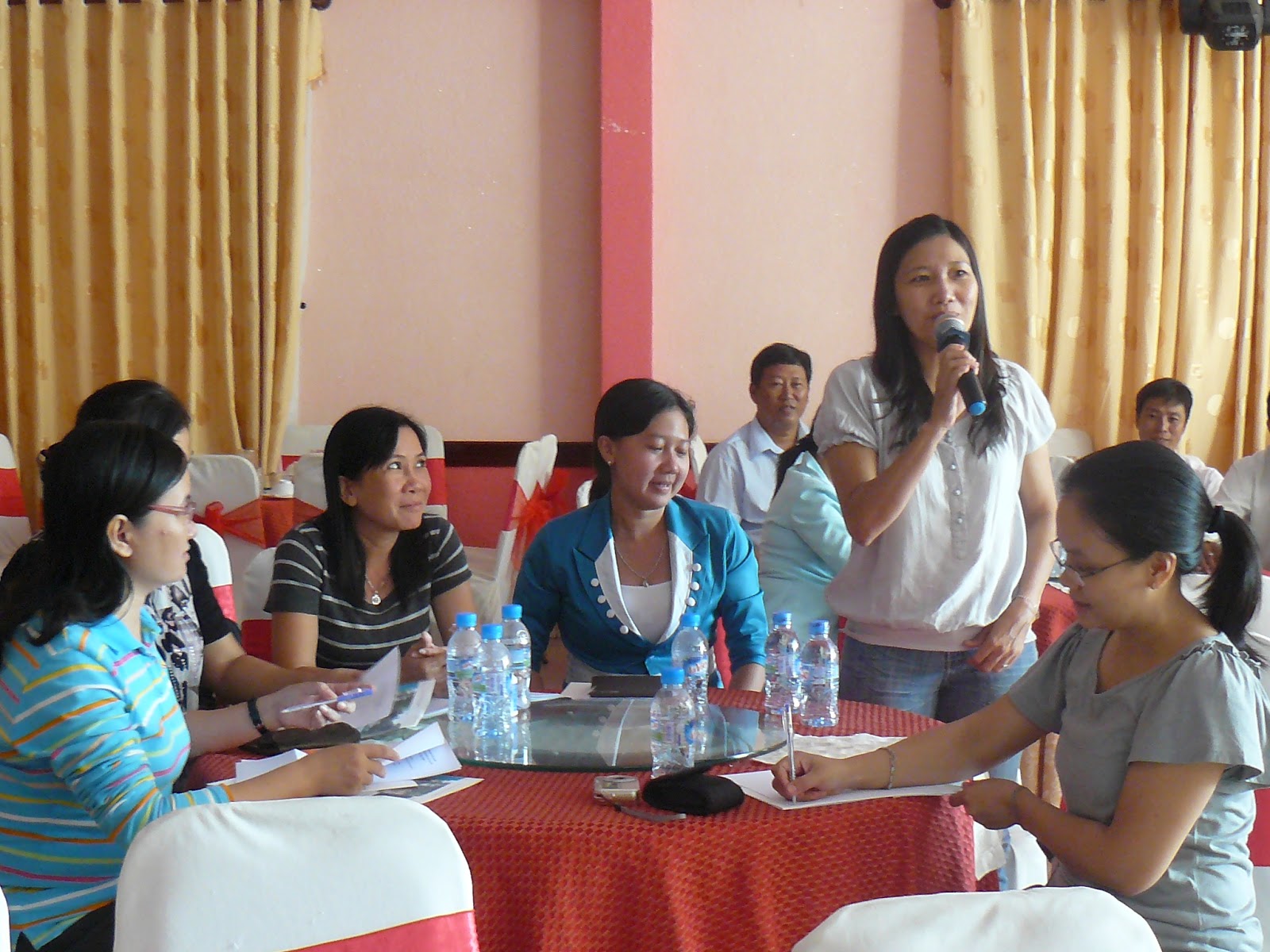
Our presentation on “Bamboo breakwater - site-specific erosion protection and adaptation to climate change in Soc Trang Province, Vietnam” received quite positive feedback. People enjoyed the time-lapse movie. Some participants said that they were impressed with the low cost of the measure. Some participants wish to visit Soc Trang someday to see the construction. One professor said that the topic is very interesting, very “Vietnam” (with bamboo), that the paper should be published and it even can be developed into a PhD thesis.
There was one question about working with local authorities/management, how to integrate and realise the research results into application in reality. I explained that our project cooperates closely with local partners such as PPC, DARD, therefore we did receive approval from them in implementation of the construction.
On the other hand, there were questions/doubts about the durability of bamboo breakwater under stormy conditions as well as longevity of the constructions in general. I explained that it is the sound installation of bamboo poles embedded underneath the soft mud, together with their sufficient size that assure the strength of the bamboo structure (which were confirmed by tension tests). Moreover, if sediment can be developed and mangroves can be rehabilitated after sometime (maybe 1 – 3 years?, we don’t know), then the breakwater would complete its mission. One participant contributed that because the waves are not so high and intense in Mekong Delta, compared to other regions in Vietnam, therefore, using bamboo here should be fine.
There was one comment about the stagnancy of water behind the T-fences that may lead to bad water quality in the area. I explained that there were gaps/spaces between the long-shore parts of the Ts where water can flow, thus, it should not be a problem.
Another concern was about the dynamic process of accretion and erosion and how we could be sure that our interference did not create erosion somewhere else. I explained that I did mention in the presentation, the construction was designed based on scientific understanding of the natural processes (with numerical modeling, field measurement, using existing data). Moreover, by recreating the former coastline, the “close to nature” conditions were made which help minimize downdrift erosion.
There were a comment that our construction seems to be more like groins than breakwater and a recommendation that we should combine bamboo with some hard (concrete/stone) structure for resilience to big storms.