
Group photo in front of DONRE Danang, 10 April 2013
Following
last year trainings and workshops to support the integrated coastal
management (ICM) process in Soc Trang, from 8 to 10 April 2013, a study
tour to Danang has been organised for representatives of local
authorities from three coastal districts and members of the
Interdisciplinary Planning Team. Aim of this study tour is for the
participants to learn from practical experiences of Danang’s good
practice on ICM application.
Before dinner on
Monday 8 March, the vice director of Danang DONRE welcomed the
delegation from Soc Trang and presented briefly about Danang’s
achievements. On Tuesday 9 March, we visited Khanh Son landfill,
Hoa Cuong wastewater treatment plant in the morning and some
developments, tourist sites along the beach of Son Tra peninsula,
climbing up to Marble mountain in the afternoon. On Wednesday 10 March,
we listened to presentations about the ICM implementation in Danang and
the ECUD GIZ project at Danang DONRE in the morning and visited the
sustainable community model in Tho Quang ward in the afternoon and then
flying back to Saigon.
Danang’s achievements
Danang
is a new established city as it has just been separated from Quang Nam
Da Nang province in 1997 to become an independent first-class city
(central controlled). In 2000, Danang was selected as one of the
national demonstration sites for integrated coastal management (ICM) in
the framework of the regional program on Building Partnerships in
Environmental Management for the Seas of East Asia (PEMSEA). Since then,
Danang has consistently implemented the ICM framework and process and
has had a comprehensive boom. Marketing and educational campaigns on sea
and environment have been conducted. Data about the sea has been
collected. Resources from the seas are used to improve coastal
communities. High value of the sea has become its trademark with
regulation for environmental protection. Environmental protection is
considered as a crucial factor to the sustainable development of the
city. Danang has refused 2 big steel and paper production projects
because of their potential pollution to environment. Drainage system,
wastewater treatment and solid waste management have been improved. All
wastewater is collected and treated before going to the sea. Danang has
developed the strategy of environmental protection for Danang up to
2010, and has conducted the project of “Danang – towards Environmental
City” up to 2020. In 2011, Danang gained the “ASEAN Environmentally
Sustainable City” Award and the National Environmental Prize.
The
economy has grown fast with its structure shifting step-by-step towards
service-industry and reduction in agricultural sector. Its macro policy
has recognised the sea as a valuable front door of the city. From
beginning of the renovation process, the city has applied land use
planning and successfully relocated hundred thousands of households with
reasonable compensation based on the fund from land auction for
development projects
[1].
As an international sea harbour, having both the sea and the mountains,
the Cham museum, Danang has taken advantage of its unique condition to
promote tourism, particularly with spiritual tourism in Kuan Yin pagoda,
Ba Na pagoda. Nowaday, Danang has been famous as the most livable city
in Vietnam. It is also the host for some international events such as
the yearly fireworks festival. The city is also proud of its beautiful
bridges, the unique rotatable Quay bridge, the dragon bridge, etc. which
serve not only for transport but also for decoration.
The
city has successfully implemented its ambitious “5 NO” campaign: no
hungry households, no illiteracy, no beggars, no drug addicts, no
murder/robbery. Danang has no longer hungry households under poverty
line. Danang is the only city in the country without wanderers for
begging. The city has been continuing the campaign with “3 YES”:
housing, jobs and urban cultural & civilized lifestyles. More
apartments/condominiums and 60 new residential areas have been built to
provide more housing. More job trainings have been conducted. Education
is considered as an important pillar for development. Poor students get
tuition remission. There is a gifted high school for excellent students
with scholarships. On the other hand, there are policies, endowment to
attract talents to work in Danang.
Khanh Son landfill
Khanh
Son landfill had been built from 2004 – 2006 with funding from World
Bank and has been in use since 2007. Its designed lifespan is for 12
years (up to 2020). We can easily observe the informal waste separation
right at the site. The landfill has 5 cells in total. Two cells had been
used up so far and the 3rd cell is currently in use. The
leachate is collected and then goes through wastewater treatment system.
The effluent meets Vietnamese standard (except color parameter). The
odor treatment is good there (using some kind of biochemist enzyme).
Operational cost of the landfill is about 6 billion VND per year. The
collected fee is 29,000 VND per tonne of municipal waste. It is planned
to build here additionally the sludge treatment system.

Khanh Son landfill

The incinerators
Medical
waste and other hazardous industrial waste are treated separately in
the 2 incinerators next to the landfill. These two incinerators are made
in Vietnam and the construction cost in total about 3 billion VND. The
collected fees are 10,000 VND/kg and 6,000 VND/kg correspondingly; which
means 10 million VND per tonne for medical waste and 6 million VND per
tonne for other hazardous industrial waste. The cost is much higher in
these cases because of the fuel used. The incinerators consume about 350
litres of diesel per tonne of these wastes. Normally, 1.4 tonnes of
these hazardous wastes are burnt every two days in 7 hours. The
incinerator has 2 chambers, one for burning waste into ash (which then
is compressed into bricks and then will be buried carefully) and the
other chamber is for burning smoke. The fuel is used mostly to burn the
smoke completely therefore no smoke escape from the system.
Hoa Cuong wastewater treatment plant
Danang
has 4 municipal wastewater treatment plants (Hoa Cuong, Phu Loc, Son
Tra and Ngu Hanh Son) using anaerobic technology for both domestic and
industrial wastewater and 1 specific wastewater treatment plant (Tho
Quang) using combining aerobic and anaerobic technology for wastewater
from aquaculture.
Hoa Cuong wastewater treatment
plant has been operated since 2007 and received domestic wastewater
from Hai Chau, Cam Le and Hoa Vang districts. The plant’s capacity is
110,799 m3 and the flow is about 30,000 m3/day. There are 2 parallel anaerobic ponds. To ensure anaerobic condition, the ponds are covered with HPDE geotextile layer.
Operation
is simple since the water flow by gravity. The wastewater is collected
by the system along Han river with pumping stations. There is a primary
settlement for sand and big size waste removal. Then the wastewater
flows through 4 channels into 2 parallel anaerobic ponds. The anaerobic
pond comprises 2 chambers. The first chamber is smaller but deeper and
it is where substrates such as sludge from septic tank are added
regularly to provide microorganism for the anaerobic treatment process.
After flowing through the first chamber, wastewater is separated into
liquid and solid phases. The water (liquid phase) continues to flow
through the second chamber and the sludge (solid phase) remains at the
first chamber. The wastewater stays in the ponds totally for 3 days
(retention time) and then the treated effluent goes to Cam Le river. The
effluent meets level B of Vietnamese standard.
The
advantages of this anaerobic technology are simple design, high
capacity, low cost for both operation and maintenance. On the other
hand, the disadvantage of this anaerobic technology is odor because of H2S, NH3
generated. However, considering the high volume and the low level of
pollution concentration of municipal wastewater, this simple technology
is okay and practical.

Hoa Cuong wastewater treatment plant
Development and tourism along Son Tra peninsula
After
lunch on Tuesday, 9 March 2013, we had chance to see some development
and tourist sites along Son Tra peninsula. It was more like a
sight-seeing tour. We visited the Kuan Yin (The Goddess of Mercy) pagoda
which has just been built in 2010. People said that since then, no more
heavy storm reaches Danang or even if there is storm, it
changes direction and thus Danang is safe. Then, we visited the Ocean
Villas, a real estate project of luxury residential area by the
Vinacapital Cooperate. This is an example of turning unused and bare
land into high value residential area. End of the excursion day, we had a
short trip to Marble mountain.

Kuan Yin pagoda
Ocean Villas

Marble mountain
ICM implementation in Danang – Experiences and lessons learned
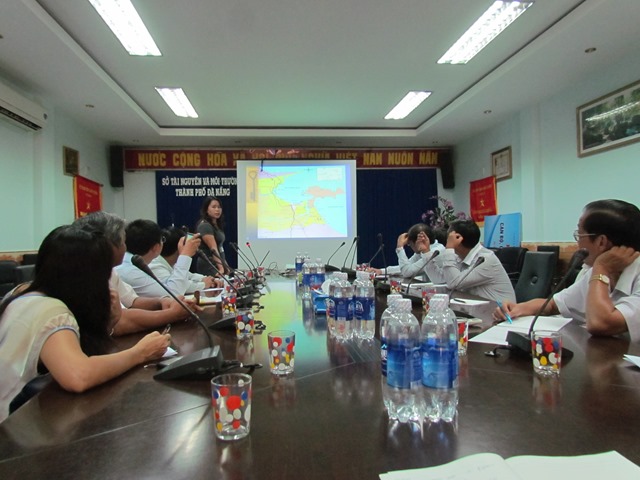
Mrs. Pham Thi Chin presenting about Danang’s ICM process
At the beginning, through MONRE, PEMSEA
[2]
approached several nominated coastal provinces including Nghe An, Khanh
Hoa (Nha Trang), Danang to introduce about ICM as a tool to achieve
sustainable development. PEMSEA saw the higher motivation, interest and
willingness from Danang local authorities among others. Then in 2000,
Danang has been chosen as the national demonstration site for ICM (2000 –
2004). Agreement was signed between PEMSEA and Danang in which PEMSEA
committed to contribute 450,000 USD and Danang contributed 907,000 USD
as counterpart fund. These fund was mostly be used for capacity building
and integrating interdisciplinary approach in management, not for
infrastructure investment.
In the preparation
step, the project office, project coordination unit, management board,
monitoring program were established. Stakeholders were identified. Core
staff got trainings from PEMSEA. Then data of all sectors were
collected. Workshops were organized for consultation to identify
environmental issues and setting priority. Environmental profile for
Danang was compiled. Vision for Danang in 50 years has been built. Based
on the vision, strategy and 44 action programs have been developed.
Danang has assigned DONRE to lead the city on the way towards becoming
one of the top 10 low-carbon-development cities in the region. The
action programs are regularly revised and adjusted. In recent year,
climate change concern has been added into the strategy.
After
the project finished, the project office has become VASI’s office in
Danang and they still keep contact with PEMSEA and PEMSEA continues
giving technical advice. The ICM project has been an important
initiative for Danang towards sustainable development. It has
strengthened Danang’s coastal governance through
[3]:
§ Creating a multi-disciplinary co-ordination mechanism for coastal resource and environmental management
Most
of the programs and development plans for the city, which are related
to coastal resources and the environment, have been prepared in
consultation with all relevant departments and districts. Community
awareness-raising, as well as capacity building for local staff,
contributed remarkably to the success of ICM in Danang. The
multi-disciplinary co-ordination mechanism helps investment projects to
fit in with the city’s coastal strategy (which considers risk
management, recovery and protection of habitat, waste management,
prevention and mitigation of pollution), and action plans for coastal
resource and environmental protection have been implemented
synchronously and harmoniously. Such as action plans include: waste
separation at source, public awareness-raising on beach cleaning,
environmental monitoring, investigation of marine resources, and project
planning for the coral reef protection zone in the Southern part of Son
Tra peninsula.

Danang’s ICM co-ordination mechanism
§ Creating technical tools to support integrated coastal resource and environmental management
Based
on the ICM strategy approved in 2001, Danang’s Peoples’ Committee
issued regulations for the management and protection of coral reefs and
ecosystems related to the coastal areas from Chao islet to Nam Hai Van
and the Son Tra peninsula.
Zonation planning for
Danang’s coastal use includes categorization of coastal spatial uses,
regulations on coastal use, a coastal use zoning plan and an
institutional framework for implementation. This zoning plan has had a
big impact on the achievement of reasonable coastal use and the
mitigation of conflict.
The Integrated
Environmental Monitoring program was approved by Danang’s People’s
Committee on May 4, 2006 with 47 monitoring points for water (covering
rivers, the sea, lakes and groundwater), sedimentation, soil, and air
quality. Since then, DONRE has co-ordinated with other related
departments to conduct regular monitoring, as well as irregular
monitoring, in order to evaluate environmental quality in the whole
city, and to assess the state of the coast.
The
Integrated Information Management System (IIMS) has been established as a
socio-economic, resource and environmental database system for Danang
for risk management, developing strategies, environmental monitoring,
and coastal use zoning, as well as other related activities supporting
state management.
§ The integrated coastal
resource and environmental management model has been widely applied by
organizations, faculties, and authorities, as well as communities
Components
of the environmental protection model, such as waste separation at
source, planting trees, etc., have been implemented by many social
organizations and unions. The movement, Green-Clean-Beautiful Sunday,
has spread all over the city. The model of the “Community club of
coastal sustainable economic development” developed by the Farmer
Association of Tho Quang ward, has been a typical model which would be
replicated in other places in the city.
§ Organizing
inspections and conducting checks on the implementation of regulations
and coastal resource and environmental protection
In
recent years, inspections, and conducting checks on the implementation
of regulations on ICM have been actively conducted, particularly in Son
Tra and Ngu Hanh Son districts.
Limitations and lessons learned
Since
ICM is a new management approach, knowledge and experience on ICM of
local staff is still limited. There is a lack of information related to
resource values, as well as a lack of human resources. Moreover, there
is lack of experts in new areas such as zonation of coastal uses and
institutional arrangements. Following are the lessons learned from the
implementation of ICM in Danang.
(1) Ensuring capacity for project operation, management and implementation
The
establishment of the Project Co-ordination Board, with the Board’s
Chairman being the Vice-president of Danang’s People’s Committee, and
with members being heads of relevant departments and districts, has
created a synchronous and united management and co-ordination system for
Danang. This has helped to mobilize the active participation of all
stakeholders in the planning and implementation of the project. The
Project Office was also founded with the selection of qualified
personnel to advise and assist the Project Co-ordination Board.
(2) Organizing public awareness-raising activities as soon as possible
Awareness-raising
activities on ICM have been organized and developed quickly for staff
of local authorities as well as for the community, in order to build a
consensus of appreciation of the importance and values of the coasts for
the city’s sustainable development. This helps to create a high level
of commitment and agreement from all stakeholders in the application of
ICM.
(3) Building consensus among stakeholders
The
support of stakeholders is essential for the success of the project.
The commitment and active direction of Danang’s Peoples’ Committee shows
a high level of determination and support for the project. This creates
favourable conditions for ICM implementation, as well as mobilizing the
interests and participation of stakeholders. Support from individuals
and the community is a prerequisite for sustaining project activities.
The active participation of departments, faculties, local authorities
and communities helps the project to identify possible challenges in its
implementation, and thereby be able to recommend solutions for
problem-solving.
(4) Role of experts
The
expert group plays an important role in providing technical advice.
Danang has organized a multi-disciplinary expert group, which includes
scientists, engineers and managers. Throughout the project, from
building strategies to implementation of sub-projects, the advice of the
multi-disciplinary group has been listened-to and considered as part of
an integrated approach to complete the project’s products and to ensure
their feasibility.
(5) Information collection
Right
from beginning, Danang started collecting relevant information for the
project. All information on environmental resources, and economic,
social, cultural, and historical aspects have been collected and
analyzed for building the database. This database is vital for the ICM
implementation.
Eco-city and climate friendly urban development project (ECUD, GIZ Danang)

Ms. Dinh Le Quan presenting about the GIZ ECUD project at Danang DONRE
The
GIZ ECUD project in Danang started in July 2011 and will end by March
2014. Its commissioning party is BMZ – the German Federal Ministry for
Economic Cooperation and Development and its implementing partners are
DPI, DONRE and Department of Construction (DOC). The project aims to
support Danang to effectively implement target programs on environment
and climate change through interdisciplinary co-ordination mechanism.
The project consists of 4 components: Environmental development strategy
(1), Environmental monitoring, assessment and report (2), Environmental
friendly master planning (3), Pilot studies on climate change
mitigation and adaptation (4).
Danang has
decided to become environmental friendly city in 2020, however the
objectives have been just limited mostly to satisfy national standards
on clean air and water rather than broader theme related to sustainable
development, green growth and resources conservation. There is also lack
of basic indicators and strategy to achieve the objectives. Therefore,
the ECUD project aims to provide consultancy to support policy
identification, building route for action plans and developing general
strategy for environmental and climate friendly urban development.
For environmental monitoring and assessment (2nd
components), activities of the ECUD project are building inventory of
emission sources, including detail information, emission map; causes
& effects modeling of environmental state in Danang and roles of
polluters (polluters pay principles); developing emission reduction plan
and action plan; revising impacts of suggested action plans by life
cycle assessment.
Danang University of Technology
with funding from the Rockefeller developed flooding model. On the
other hand, CDM Smith consultant company with funding from World Bank
developed the urban drainage model for Danang. None of these models has
been used in policy analysis. The master plan and infrastructure
decisions have been made without support of modeling. Therefore, the
ECUD project aims to combine these flooding and urban drainage models
into one integrated model, developing respectively scenarios to analyse
policies for recommendation on development strategy and master planning
of the city.
The ECUD project also conducts
pilot studies on composting, climate-resilient house for replication in
Danang and other cities in Vietnam.
The GIZ
project Environmentally and Climate-friendly Urban Development (ECUD) in
Da Nang has received a certificate of merit by the People’s Committee
of Da Nang City in January 2013. The honorary certificate is awarded
annually to groups and individuals in recognition of their contribution
to Da Nang’s socio-economic development.
Sustainable development community in Tho Quang ward

Mr.
Nguyen Dinh, head of the Farmer Association of Tho Quang presenting
about the club for sustainable development of coastal community at
People’s Committee of Tho Quang ward
The club for sustainable
development community in Tho Quang ward, Son Tra district has been
established in 2010. It serves as the pilot model for later replication
into other places in the city. Goals of the model are raising legal
awareness on coastal environmental and resources protection and
management, improving coastal environment through mobilizing public
participation, sustainable use of resources and economic development at
Son Tra peninsula.
The club has 37 members and
they have meetings quarterly. The regulation on coastal environmental
protection has been developed and agreed among the club’s members. This
core group then has mobilized a larger number of people in the community
to sustainably use the coastal resources and to protect the
environment. The club has taken care of the environment along 2.5 km
coastline in Tho Quang ward. They have detected and timely prevented 2
incidents of illegal seaweed collecting in the forbidden zone along Son
Tra peninsula.
With support from the ICM
project, since October 2010, three trainings, workshops have been
organized for farmers and fishermen in the area to raise public
awareness on community role in integrated coastal management and
environmental protection. The club has distributed 1000 flyers on roles
of farmers in building environmental friendly city. Together with the
Farmer Association, the club has mobilized people to participate in 12
environmental events of “Green, Beautiful, Clean Sunday”. Moreover, 25
members of the club have joined the rehearsal on responding to
environmental risks organized by the city.
The
club has encouraged members and other aquaculture/fishermen households
in the coastal area to apply alternative livelihoods; so far, 5
households have shifted from aquaculture to tourist services. Three
small capacity vessels have been converted into tourist boats, creating
jobs for 14 people, including 5 club members.
Mr.
Dinh, head of the club mentioned that they want to support more and
more households’ livelihood, but the most difficult thing is the limited
funding. It was recommended from the discussion that they can focus
more on the task of raising community’s awareness because supporting
alternative livelihoods for people there would be beyond their capacity
and that can be taken care by other bigger projects.
[1]
From Danang’s perspective, this initiative of land auction policy is a
successful tool to create fund for the city’s urban development. On the
other hand, from the state perspective, there is some legal violation
related (see the link below). In my opinion, Danang has taken innovative
policies and they have their reasons.
http://english.vietnamnet.vn/fms/government/69035/conclusions-about-da-nang-s-land-related-violations-have--legal-basis-.html
[2] PEMSEA members including China, Japan and 10 Southeast Asian countries
[3] Some old notes from the ICAM training in June 2012 are put additionally in this session.


