Monday, August 15, 2011

4. Ecological balance - City as a regenerative and symbiosis system

“Cities can become more sustainable by modeling urban processes on ecological principles of form and function, by which natural ecosystems operate. The characteristics of natural ecosystems include diversity, adaptiveness, interconnectedness, resilience, regenerative capacity, and symbiosis.” (Newman and Jennings 2008)


City as a regenerative and symbiosis system

The core philosophy of sustainability lies in the appreciation of nature as the symbol of integrity, stability and beauty. Sustainability deals much with creative designs and planning in harmony with nature. From the perspective of sustainability, nature’s design and technologies are far superior to human science and technology (Sterry 2010).

In nature, nothing is useless, nothing is waste but everything is resource for other process in the sophisticatedly interconnected web of life, where circular metabolism is the principle of ongoing self-renewal system. Thus, a sustainable system is a regenerative system that mimics nature’s circular patterns, replacing the present linear flows with cyclical flows.

On a predominantly urban planet, cities will need to adopt circular metabolic systems to assure their own long-term viability as well as that of the rural environments on which they depend; outputs will need to become inputs into the local and regional production system (Girardet 2010). Most importantly, it is crucial to return organic waste into plant nutrients, for assuring farmland’s long-term fertility. By recycling wastes back into the system, it also minimizes pollution. Sustainably using renewable resources, instead of fossil fuels and chemicals is also more resource-conserving, healthy and less environmentally damaging.

On the other hand, creating a circular urban metabolism can create resilient cities and create many new local businesses and jobs (Girardet 2010). About resilience, Melissa Sterry is developing the model of Bionic City[1], which embraces nature’s approach to building complex infrastructures: “Whereas the conventional city is a mass of static, disconnected and inert structures operating independently and irrespective of one another and their environment, the Bionic City operates as an interconnected and intelligent ecosystem in which every entity is engaged in an ongoing symbiotic relationship with all others, from the molecular to the metropolitan in scale. Beyond preventing the problems traditionally associated with flooding, the Bionic City will also feature the means to utilise excessive quantities of water, including hydropower and water harvesting technologies.” According to Melissa Sterry, the sensitivity the city has with its surroundings is key to its ability to predict and prepare for environmental changes.

One essential characteristic of nature systems that helps maintaining stability in constantly changing conditions is diversity (Holmgren 2002). Multiple associations nurture each life form, thereby increasing the stability and resilience of the whole system. In natural system, everything is connected to everything else, each important function is supported by many elements, and each element performs many functions. Thus, this provides the thinking of multiple pathways to achieve one goal as well as a common solution to disparate problems (Lyle 1994). For instance, rainwater infiltration with thoughtful design can replenish groundwater, create landscape, as well as reduce urban flooding…

The idea of solving problems simultaneously is also the main theme of SymbioCity[2], an urban sustainability approach by Sweden. Symbiosis means the integration of two or more organisms in a mutually beneficial union. Looking at the city as a whole, we find benefits through synergies in urban functions such as combination of industrial waste heat with the municipal energy plant, combination of architecture and landscape planning…

SymbioCity means urban resource efficiency – across and between different urban technological systems, letting nothing go to waste; combining energy, waste management, water supply and sanitation, traffic and transport, landscape planning, architecture and urban functions for new and better solutions as well as a more efficient use of natural resource (SymbioCity 2009).

There are many ways to make an urban function effective, but focusing on them individually may let us miss out the synergies between them, which can only be found with a holistic approach. Therefore, an integrated planning approach is key to unlocking hidden synergies in the city. Instead of managing urban sectors one by one, SymbioCity combine them, saving valuable city resources and creating new values (SymbioCity 2009).

Urban ecology and integrated land use

As the spirit of sustainability lies in the heart of nature, protecting and restoring ecology within urban areas, bringing nature back into city is an essential theme in urban sustainability. Green spaces in cities offer us a lot of benefits. They provide shading, filtering the air, enriching urban biodiversity, reducing urban heat island effect, thus simultaneously making bioclimate comfort and lowering energy use for cooling. “Urban ecology uses climate- and region-appropriate plants, xeriscaping[3] to minimize the need for fertilizer and water, and uses land for multiple functions such as food production, wildlife habitat, recreation and beautification” (Roseland 2005). Urban ecology also acknowledges the role of water and urban aquatic systems – streams, ponds, rivers in revitalizing cities. Besides those ecological advantages, thoughtful urban designs in concert with nature and embracing culture of a place also have many aesthetic values, social and psychological healing benefits. Green public spaces can enhance community connection and interaction, providing places to contemplate, play, relax and meditate.

Since land use permeates nearly all urban aspects, appropriate land use is a decisive factor for a sustainable city. In order to be sustainable, city should minimize land consumption, integrating green spaces and preserving farm land for food security as well as for other ecological functions. It is not always easy as land is a limited resource and the cost of real estates is often too high, while cities have to balance among conflicts of urbanization, development, population pressure with environmental and social goals. Therefore, symbiosis integrating planning or whole systems design[4] for multi-purpose use can help afford this balance. Many examples illustrate this concept (Roseland 2005): green roof, solar photovoltaic panel on rooftop (no extra space needed); parks, urban gardening as both recreation areas and edible landscaping; constructed wetlands as sewage treatment facility, natural habitats, recreation areas, drainage for rainwater run off…

Urban agriculture

Urban agriculture or urban farming can be understood as farming within and around cities. “Urban agriculture is a dynamic concept that comprises of a variety of farming systems, ranging from subsistence production and processing at household level to fully commercialized agriculture” (Zeeuw et al. n.d.).


Urban agriculture as a tool for sustainable urban development
(adapted from Zeeuw)

In response to serious problems of poverty, food insecurity, and environmental degradation, there is a growing attention and promotion of urban farming all over the world, along with the movement of resilient, self-sustaining and low carbon cities. Increasingly, urban farming has been seen as part of sustainable urban development.

Urban farming can contribute to a food secure and inclusive city, a productive and environmentally healthy city (fig. 3.5). Therefore, it is necessary to acknowledge the links between urban agriculture and various policy target areas, such as the alleviation of poverty, economic development, or environmental protection, in order to justify the inclusion and mainstreaming of urban agriculture into municipal policies and public support programs (Zeeuw et al. n.d.).

The most striking feature of urban farming, which distinguishes it from rural agriculture, is its integration into the urban economic and ecological system (RUAF)[5]. Urban farms and gardens complement rural agriculture in local food systems and can also become an important income supplement for households. Since food production is close to home and market, it helps reduce energy for transportation and packaging costs. This is also helpful in situations when supply chains from rural areas have been interrupted and cities are unable to receive food imports (Worldwatch 2011). Another essential benefit of urban agriculture is that it can contribute to waste management and nutrient recycling by turning urban wastes into a productive resource, thus reducing the use of expensive chemical fertilizers and improving local soil fertility (Veenhuizen and Danso 2007).

In his theory of Food Urbanism (2009), Jason Grimm showed that urban food system of production, processing, distribution, marketing, consumption and waste management can become infrastructure that transforms urban experience by thoughtful sensitive design and planning. According to Grimm, food production can be integrated into the daily activities of community residents through recreation and communal gatherings. Community gardens can also provide beautiful and pleasing spaces, helping improve the air quality in urban areas. And through cooperative market outlets, a larger series of food access points can be developed, supplying healthy fresh and affordable food.


[1] “Bionic City”- article on Earth 2.0 magazine: http://earth2channel.com/magazine/article/22
[2] More on SymbioCity: http://www.symbiocity.org

[3] Xeriscaping refers to landscaping and gardening in ways that reduce or eliminate the need for supplemental water from irrigation
[4] Whole systems design concept for sustainability: http://www.wholesystemsdesign.com
[5]  RUAF – Resource Centres on Urban Agriculture & Food Security: What is urban agriculture? http://www.ruaf.org/node/512


3. Principles for Sustainability

    “Vision is seeing the potential purpose hidden in the chaos of the moment, but which could bring to birth new possibilities for a person, a company or a nation. 
Vision is seeing what life could be like while dealing with life as it is.
Vision deals with those deeper human intangibles that alone give ultimate purpose to life. In the end, vision must always deal with life’s qualities, not with its quantities.”
(Van Duisen Wilhard) 


Principles for Sustainability

Sustainability literally means the capacity to endure over time. Symbolically, it refers to what is of true values, what is good, genuine and resilient, which can stand the test of time. Sustainability associates with balance and equity in a comprehensive approach, which acknowledges our dependence on the health of natural systems for our survival and well-being, the limit carrying capacity of the Earth and the detrimental impact of unchecked human activities (Edwards 2005). Thus, sustainability strives for balance among the interconnected ecological, economic and social systems. As implied from the most popular definition of sustainable development  ("Sustainable development is development which meets the needs of the present without compromising the ability of future generations to meet their own needs”, the Brundtland report 1987), sustainability requires a long term, intergenerational perspective. Equity should be maintained, not only across communities within generation but also between generations.

*****


The Earth Charter is a global consensus, a product of a decade-long, worldwide, cross-cultural dialogue on common goals and shared values. As “a vision of hope and a call to action”, it provides us with inspiration and guidance to a sustainable future. In October 2003, UNESCO adopted a resolution recognizing the Earth Charter as an important ethical framework for sustainability (ECI Secretariat 2011). Main principles of the Earth Charter are summarized here:
THE EARTH CHARTER’S PRINCIPLES

Respect and Care for the Community of Life:
    To respect Earth and life in all its diversity;
    To care for the community of life with understanding, compassion and love;
    To build democratic societies that are just, sustainable, participatory and peaceful; and
    To secure Earth's bounty and beauty for present and future generations.
In order to fulfill these four broad commitments, it is necessary to:
Ecological Integrity
    Protect and restore the integrity of Earth's ecological systems, with special concern for biological diversity and the natural processes that sustain life.
    Prevent harm as the best method of environmental protection and, when knowledge is limited, apply a precautionary approach.
    Adopt patterns of production, consumption, and reproduction that safeguard Earth's regenerative capacities, human rights, and community well-being.
    Advance the study of ecological sustainability and promote the open exchange and wide application of the knowledge acquired.
Social and Economic Justice
    Eradicate poverty as an ethical, social, and environmental imperative.
    Ensure that economic activities and institutions at all levels promote human development in an equitable and sustainable manner.
    Affirm gender equality and equity as prerequisites to sustainable development and ensure universal access to education, health care, and economic opportunity.
    Uphold the right of all, without discrimination, to a natural and social environment supportive of human dignity, bodily health, and spiritual well-being, with special attention to the rights of indigenous peoples and minorities.
Democracy, Nonviolence, and Peace
    Strengthen democratic institutions at all levels, and provide transparency and accountability in governance, inclusive participation in decision making, and access to justice.
    Integrate into formal education and life-long learning the knowledge, values, and skills needed for a sustainable way of life.
    Treat all living beings with respect and consideration.
    Promote a culture of tolerance, nonviolence, and peace.
The spirit of the Earth Charter is beautifully highlighted in the core principle of Respect and Care for the Community of Life: respect Earth and life in all its diversity, care for the community of life with understanding, compassion and love. It helps us to recognize what is deeply and fundamentally important to us – our connection with each other and with the natural world. That holistic worldview leads us to do no harm and cooperate with nature, with all other humans and other living beings in the web of life.

One Planet Living  is a global initiative developed by BioRegional  and WWF .  While the Earth Charter is an ethical framework, the One Planet Living’s sustainable city concepts are more of a practical vision that helps us to focus on how we can take action for a sustainable future.
The Ten Principles of One Planet Living

http://www.middlesbrough.gov.uk/ccm/cms-service/stream/asset/?asset_id=13627315

(Source: BioRegional and WWF)

The Philips Center's framework for Livable Cities- In the urban context, sustainability can be perceived as visions of livable and lovable cities (The Philips Center for Health & Wellbeing 2010). Experts from the Philips Center have identified three important interlinked ingredients of a livable city: resilience, inclusiveness and authenticity.

http://cdn.theatlantic.com/static/mt/assets/food/5638409929_09ec975fae_b_d.jpg
(Soucre: The Philips Center)
In their conceptual framework for urban sustainability, think tank of the Philips Center pointed out that these three essential attributes of a livable city should present in all dimensions of sustainability (social, cultural, economic, technical and environmental).

So, a livable city should be a resilient city, environmentally, socially and economically; this is particularly true in the growing context of climate change, as resilience is about adaptability, flexibility, the ability of a city to balance continuity with change. A resilient city is a “strong” city which has inner strength to help it remain stable through shocks and stresses. A livable city is also an inclusive city, which cherishes social integration and cohesion. Moreover, a livable as well as lovable city usually has its own unique identity.

VISION OF A LIVABLE & LOVABLE CITY
(The Philips Center 2010)

Resilience
    Preservation of biodiversity and ecosystems for local environmental quality
    Energy, food, water, materials at low global ecological footprint
    Green areas and water as environmental mitigation factors, parks as “lungs” of a city
    Cultural diversity, multiple lifestyle, continuity and change, tradition and innovation
    Adaptability, regeneration, transformation, interdependency, systems view
    Economic diversity, local entrepreneurship, job creation…

Inclusiveness
    Public green areas as outdoor gyms, recreational spaces, social bridges…
     Empowerment, justice and freedom
    Equitable access to resources, rights to public goods and services
    Social participation, economic inclusion
    Cultural diversity and integration, tolerance
    Sense of ownership, security and safety

Authenticity
    Local ecosystem for local identity, native species as uniqueness of a place
Natural heritage as collective memory
Connection between people and nature
Historical heritage and identity
Valuable local knowledge and culture
Appropriate innovation and choices of change
Cultural and technological rootedness
Sense of place, belonging and pride
Connection between people and people, people and land

Ecocity features main characteristics of an ecocity model envisioned by experts of Ecocity Builders , using integrated, whole systems approach for city design, building, and operations in relation to the surrounding environment and natural resources of the region (Ecocity Builders 2010).


Principal features of an ecocity
(adapted from Ecocity Builders)

The following parts will discuss briefly more concepts and models for urban sustainability, in terms of its interrelated dimensions, ecological balance, economic development, social cohesion, cultural vitality and good governance for sustainable urban development.

Friday, August 12, 2011

2. Backcasting and systems approach

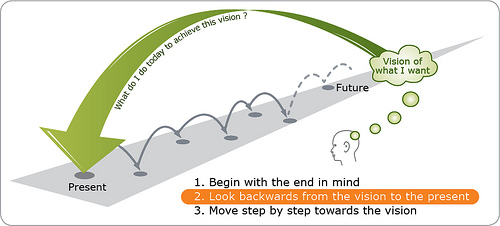
Backcasting (Source: The Natural Step*)

Visionary (backcasting) and holistic (systems) approach was used in dealing with urban challenges and building the framework for sustainability. The concept of “backcasting” is a way of planning which begins with the vision of what we want in the future, and then goes back to the present, figures out what we have to do to get there. Having first a desirable vision in mind is a powerful step to manifest it in reality. As visions provide inspiration and guidance for decision-making towards sustainability, they allow us to ensure that our actions and strategies aligned with the direction we want to head and as efficiently as possible. 

Since backcasting starts with the final end, the image of the desired outcome, it usually refers to long time frames, where there is great uncertainty and less control over what may happen. Hence, the future vision may usefully be defined using principles rather than specifics (Outhwaite 2009). Backcasting does not describe for measurable and fixed targets and goals, but rather for flexible, evolutionary and continuously re-created visions. 

“Backcasting is an opportunity to let go of the current reality for a moment and freely imagine what might be possible” (Outhwaite 2009). As forecasting mostly based on current trend, it tends to present a more limited range of options, hence stifling creativity and new possibilities, and more important, it projects the problems of today into the future. “When we start with problems, often the vision is limited to having fewer problems, or solving an isolated problem; it does not necessarily encompass how we can satisfy one’s needs more effectively, or how we can live rich and meaningful lives” (Hallsmith 2003). As Albert Einstein once said “the significant problems we face cannot be solved at the same level of thinking we were at when we created them”, backcasting is particularly useful when current trends are part of the problems that we are trying to tackle. Thus, though forecasting is very effective if we are happy with current situation, if what we want is a very different future than the one we are headed toward, that is when we need to backcast (Baxter et al. 2009). 

In brief, backcasting is looking at the current situation from a future perspective, which allows complex problems to be approached by let us first simply focus on outcomes, then think backwards to identify numerous potential pathways to reach the desired outcomes. In turn, exploring many alternatives makes it easier to find solutions that best fit and optimize all of the parts and relationships within the system toward achieving these outcomes (Haines et al. 2005). Therefore, backcasting is a helpful methodology in planning for urban sustainability because of the complexity of urban challenges and the need to develop new ways of doing things to address them. 

Backward thinking is the core of where to start in systems thinking, a systems view and comprehensive approach that can help us to design smart and enduring solutions to problems. Systems thinking is a holistic approach which encourages us to see the “whole” - the bigger picture, so that we can structure more effective, efficient and creative system solutions. 

The systems view looks at the world in terms of relationships and integration, recognizing the essential interrelatedness and interdependence of all phenomena – physical, biological, psychological, social, and cultural (Capra 1988). “In order to understand what’s behind our sustainability challenges, we need to step back and look at the big picture, see the connections, identify the root causes of our problems and find the leverage points for change” (Baxter et al. 2009). 

Systems approach attempts to widen the circle of understanding in order to comprehend the connections that exist between all things in the web of life. It is a continuing process that involves honoring the past, being present, looking ahead, and keeping future generations in mind (Newman and Jennings 2008). Identifying cause – and – effect relationships requires us to see not only bigger but deeper, further in all dimensions of space and time. The following quote by Grazia is a beautiful metaphor on contemplation through longer time frames to recognize patterns: “Imagine you want to shoot an arrow. The further back you pull the bowstring, the further the arrow flies. The same is true for our own understanding and vision. The further back we look into history, the further we can see into our future” (Grazia 2009).

The holistic approach towards sustainable urban development is a strategic thinking to address the complex challenges of our urban issues. Thus, urban sustainability visions should encompass an integrated and interdisciplinary framework in which cities are considered as parts of larger natural ecosystems and socio-economic communities.

(excerpt from my thesis - to be continued)


[*] More on backcasting at "The Natural Steps – Backcasting": http://www.naturalstep.org/backcasting